


Most people come to Tarifa for the wind. Very few arrive knowing that the town is named after a Berber commander, that its castle is the setting for one of the most severe acts of sacrifice in Spanish history, or that a complete Roman town lies on an empty beach twenty kilometres up the coast.
Tarifa has mattered strategically for as long as ships have passed through the Strait — which is to say, for all of recorded Mediterranean history.
Phoenicians, and the fish
The Phoenicians worked this coast three thousand years ago. They brought the almadraba, the tuna-trapping method still used off Tarifa every spring.
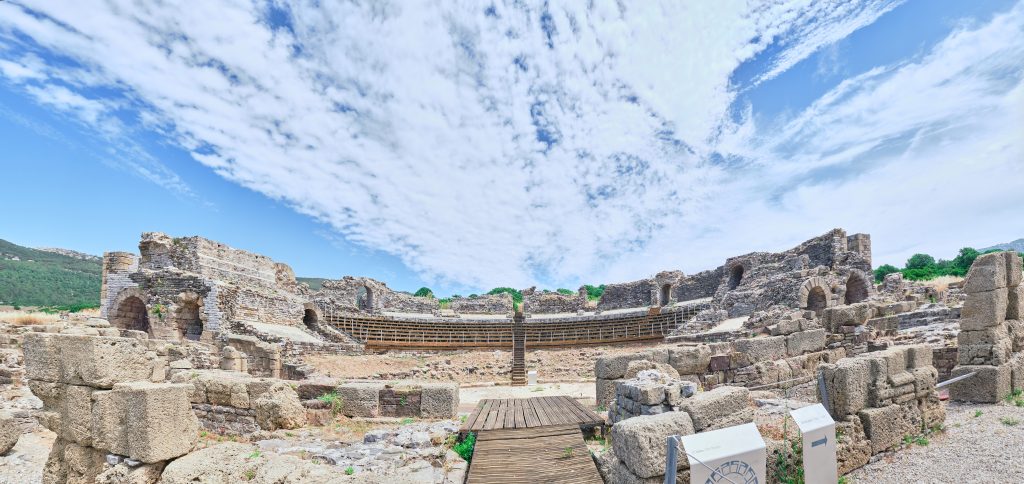
The Romans industrialised it. At Bolonia, they built Baelo Claudia — forum, basilica, theatre, temples, and an enormous fish-salting quarter.
Baelo Claudia’s wealth came from garum, a fermented fish sauce that was among the most valuable trade goods in the empire. The salting vats remain, cut into stone metres from the sand beneath a vast shifting dune. It is one of the best-preserved Roman towns in Spain, and it sits on a beach with almost nothing else on it.
710 AD, and a name
In 710 AD a Berber commander named Tarif ibn Malik landed on this coast on a reconnaissance raid — a year before the main Muslim invasion of Iberia.
The town carries his name. Tarifa is, literally, Tarif’s place.
For five centuries it belonged to Al-Andalus. The castle was built in 960 AD under the caliph Abd al-Rahman III, guarding the narrowest point of the Strait. Much of what stands today is that original fortress.
1294
The story that defines this town happened at that castle.
Tarifa was held for Castile by Alonso Pérez de Guzmán. Besiegers — among them the rebel Infante Don Juan, the king’s own brother — held Guzmán’s young son hostage. They brought the boy before the walls and demanded surrender.
Guzmán threw his own dagger down from the battlements for them to use, and returned to the defence.
His son was killed. Tarifa did not fall. He has been Guzmán el Bueno ever since, and the castle carries his name.
Whatever one makes of it as a moral proposition — and opinions here are not uniform — it explains a great deal about how this town understands itself. The walls he defended are the walls you can walk.
Two continents, two seas
Tarifa is the southernmost point of continental Europe. From the causeway to the Isla de las Palomas you stand where the Atlantic becomes the Mediterranean, with Africa fourteen kilometres away and visible on most days.
This is not trivia. It is the reason for everything else: the shipping, the Levante and Poniente that made this a windsurfing capital, the whale migrations, and the bird crossings that bring naturalists here twice a year.
Every power that has ever mattered in this sea wanted this point. That is the town’s history in a sentence.
What is actually worth seeing
- Castillo de Guzmán el Bueno — the 10th-century fortress and the battlements of 1294
- Baelo Claudia, Bolonia — Roman town and salting works, on the beach beneath the dune
- The medieval old town — the Puerta de Jerez, the whitewashed lanes, San Mateo
- Isla de las Palomas — the southernmost point of continental Europe
- The Roman road and quarries near Bolonia — unmarked, and usually completely empty
How we open it up
Baelo Claudia at the right hour. The site closes to coaches long before the light gets interesting. We arrange private visits with an archaeologist in the late afternoon, when the dune is gold and there is essentially nobody there. It is the single most memorable thing we book on this coast, and almost no visitor does it.
The castle, with someone who knows it. A guided walk of the walls with the 1294 siege told properly, rather than read off a panel.
The quiet Roman sites. The road, the quarries, the stretches that are on no itinerary. Best on foot, early.
Staying inside the history
Bolonia — our villas there are within walking distance of Baelo Claudia. Wandering down to the ruins in the evening is not an excursion; it is what you do after dinner.
Los Lances and Betis — the old town and the castle within easy reach.
El Cuartón — looking directly out over the Strait that all of this was fought over, with Africa on the far side.
Tell us what interests you and we will arrange someone who genuinely knows it.