

Some of these are common knowledge in the town and unknown to almost every visitor. A few surprise people who have been coming here for a decade.
1. The town is named after a person.
Tarif ibn Malik, the Berber commander who landed here in 710 AD on a reconnaissance raid — a year before the main Muslim invasion of Iberia.
2. It is the southernmost point of continental Europe.
Not Gibraltar. The Isla de las Palomas, joined to the town by a causeway, is the southernmost land on the European mainland.
3. You can see another continent from the terrace.
Africa is fourteen kilometres away, visible on most clear days. On the clearest, buildings in Tangier. Several of our villas in El Cuartón and Betis look straight at it.
4. Two seas meet here.
The Atlantic and the Mediterranean converge in the Strait, and the line between them is often visible from the air as a change in colour — different salinity, different density.
5. A father let his son be killed rather than surrender the town.
In 1294, besiegers threatened to kill the young son of the castle’s defender unless he gave up Tarifa. He threw down his own dagger for them to use. The boy died; the town held. He has been Guzmán el Bueno ever since.
6. The castle is over a thousand years old.
Built in 960 AD under Abd al-Rahman III to guard the narrowest point of the Strait. Still standing. You can walk the walls.
7. A complete Roman town sits on a nearby beach.
Baelo Claudia at Bolonia — forum, theatre, temples and an industrial fish-salting quarter, metres from the sand beneath one of Europe’s largest shifting dunes.
8. The Romans made a fortune here from fish sauce.
Baelo Claudia’s wealth came from garum, traded across the empire at extraordinary prices. The stone vats are still in the ground.
9. The tuna are still caught the same way, three thousand years on.
The almadraba net-maze was introduced by the Phoenicians and is still worked off Tarifa, Zahara, Barbate and Conil every spring.
10. The wind has two names, and the town runs on which one is blowing.
The Levante arrives hot and strong from the east; the Poniente cooler and steadier off the Atlantic. It determines the beach, the sport, and — locals will tell you — the mood.
11. It is one of Europe’s best places to see whales.
Resident pilot whales and dolphins, with sperm whales and orcas passing seasonally.
12. It is a global bottleneck for migrating birds.
Hundreds of thousands of storks and raptors cross here twice a year, because it is the shortest crossing between Europe and Africa and soaring birds avoid open water.
13. Windsurfers arrived about twenty years before kitesurfers.
Tarifa’s reputation was built in the late seventies and eighties on windsurfing. Kites only took over in the 2000s.
14. Its name may survive in a word you use.
It is widely held locally that Spanish tarifa and English tariff come from the town, via tolls on ships passing the Strait. Etymologists generally trace the word to the Arabic taʿrīf — notification — which is the same root that gives the town its name through Tarif ibn Malik. The connection is real; the direct route through the town is the disputed part.
Seeing them properly
Nearly all of this is within half an hour of the town. Baelo Claudia and the castle fit comfortably into one day — though we would rather send you to the ruins in the late afternoon, with an archaeologist and no coaches, than at midday with everyone else.
The seasonal ones are worth planning around: spring and autumn for the bird migration, late April to mid-June for the almadraba.
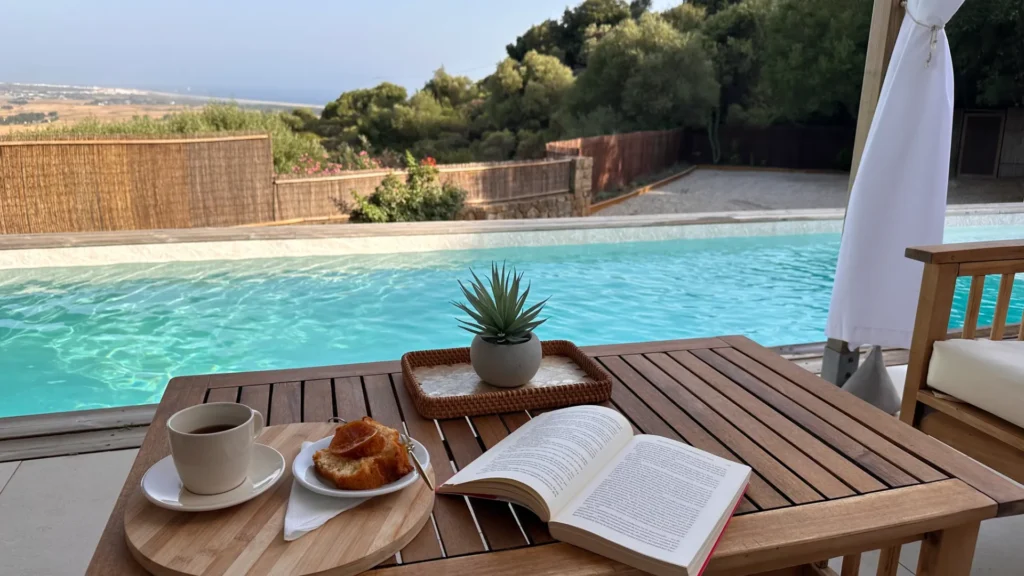
Our villas in Bolonia sit beside the Roman town; those in El Cuartón and Betis look out over the Strait where the whales, the birds and the tuna all pass.
Tell us when you are thinking of coming and we will tell you honestly what will be happening.